

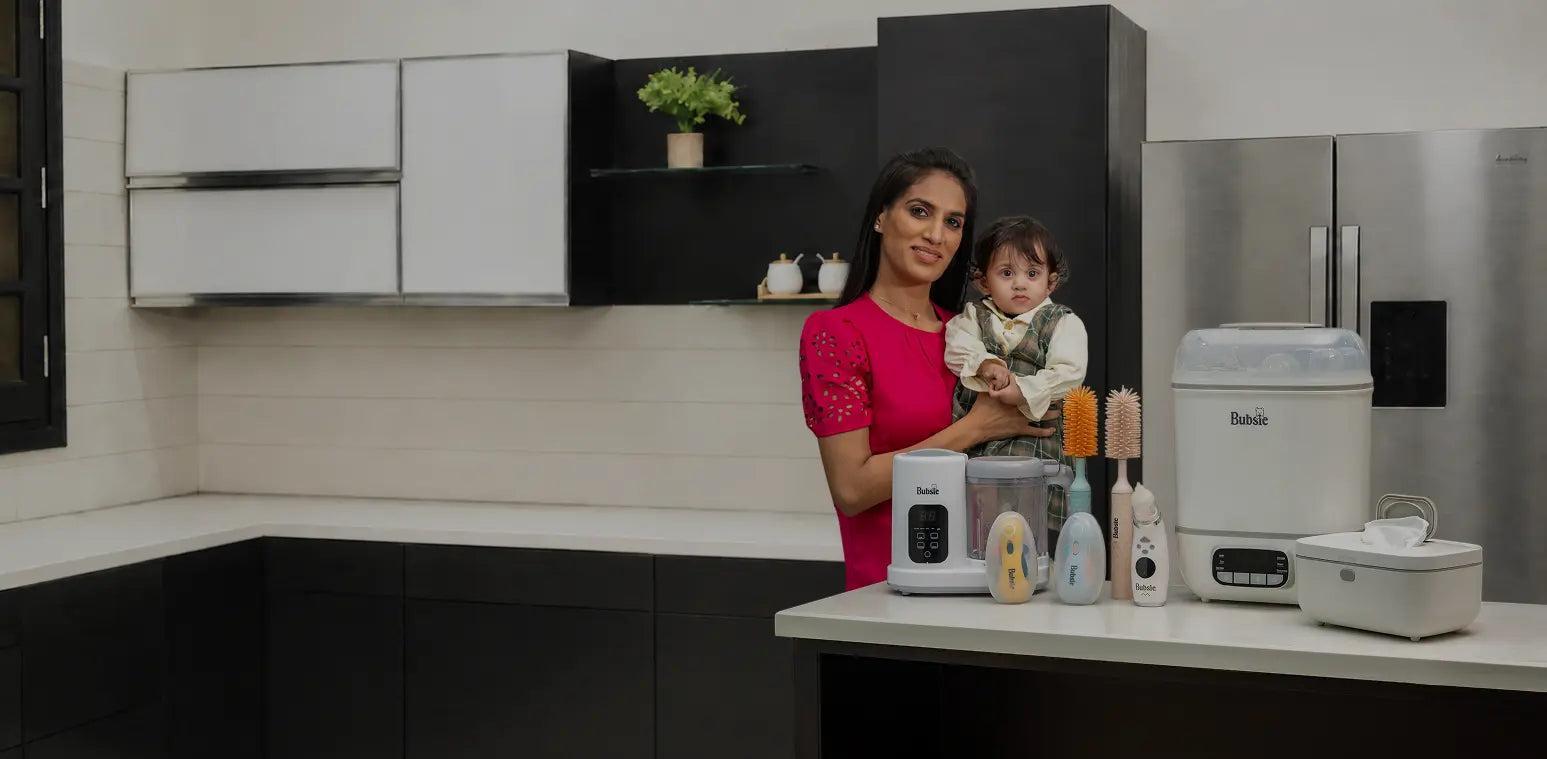
Punjab, India, August 2026: More and more Indian parents are swapping old-school baby-care habits for simple electric tools. Instead of boiling water to sterilize bottles, mashing food by hand, or using cotton swabs to clear a baby’s blocked nose, parents are now reaching for easy, one-touch devices that do the job faster and more safely. This isn’t just happening in big cities; it’s catching on in smaller towns too, and experts say it’s quickly becoming the new normal for how young parents in India care for their babies.
According to Mordor Intelligence, India’s baby care products market was valued at USD 5.18 billion in 2025 and reached USD 5.57 billion in 2026, with the industry projected to grow to USD 9.72 billion by 2031. Notably, online retail sales for baby care are advancing at a 12.47% CAGR through 2031, the fastest-growing channel in the category. This is the backdrop against which brands like Bubsie are positioning electric, smart baby-care tools as everyday essentials rather than luxury add-ons.
This report examines what is driving the shift toward electric baby-care equipment in India, what parents should know before buying, and how the Bubsie product range fits into this evolving category.
Why Is Electric Baby Care Gaining Popularity in India?
Several converging factors are pushing Indian households toward electric and semi-automated baby-care tools:
- Dual-income households: More Indian parents, particularly in urban centers, are working full-time, leaving less time for manual, repetitive infant-care tasks such as bottle sterilization or food preparation.
- Rising hygiene awareness: Post-pandemic behavior shifts have made sterilization and germ control a non-negotiable priority for new parents, not an occasional practice.
- Nuclear family structures: With fewer multigenerational households to share caregiving duties, parents are looking for tools that reduce manual workload without compromising safety.
- E-commerce accessibility: Increasing digital penetration and the expansion of organized retail networks have made specialized baby-care appliances, once available only in select stores, accessible via direct-to-home delivery, even in tier-2 and tier-3 cities.
- Preference for premium, tested products: Indian parents are increasingly associating safety and dermatological or hygiene testing with product credibility, rather than simply price or brand recall.
Government data reinforces the scale of this demand. India records an annual birth rate of approximately 26 million, and roughly 25% of India’s population falls within the 0–14 age group, according to World Bank figures cited by Mordor Intelligence. That sustained base of new parents each year is what analysts point to when explaining why the baby-care appliance segment continues to expand well beyond metro cities.
Industry Overview: A Market in Formalisation
The Indian baby care sector has historically been fragmented, dominated by unbranded, low-cost manual products sold through general stores and pharmacies. That is changing.
Industry analysts at IMARC Group describe the sector as undergoing rapid formalisation, transitioning from a fragmented commodity trade to a high-margin, brand-led retail ecosystem driven by aggressive premiumisation across urban demographics. This shift matters for parents because it signals a market where product testing, quality control, and after-sales support are becoming standard expectations rather than exceptions.
Within this formalizing market, baby toiletries and skin care are expected to capture around 32% of total retail revenue, while baby skin care specifically is the fastest-growing segment, projected at a 12.59% CAGR through 2031. Electric feeding, sterilization, and grooming appliances sit adjacent to this trend, an extension of the same parental instinct to seek out solutions that are safer, faster, and more consistent than manual alternatives.
Current Market Trends Shaping Indian Baby Care in 2026
1. Premiumization Is Replacing Price-First Buying
Parents are increasingly willing to pay more for products with demonstrable safety credentials. A growing preference for organic and natural formulations, supported by BIS, FDA, RoHS, and CE certification, is driving a 13.88% CAGR for that segment, a pattern that mirrors rising expectations for electric appliances used directly with infants, such as sterilizers and nasal aspirators.
2. Online Channels Are Now the Primary Discovery Point
With online retail growing at 12.47% CAGR, the fastest of any distribution channel, parents are researching, comparing, and purchasing baby-care appliances almost entirely through digital platforms, often reading independent reviews before deciding on a product.
3. Convenience-Led Product Categories Are Expanding Fastest
Analysts at Technavio note that the baby food segment is evolving beyond basic nutrition, driven by consumer focus on specialized solutions such as nutrient-dense meals and fortified infant cereals that support developmental milestones, with convenience factors like on-the-go feeding solutions gaining significant traction. This same convenience-first mindset is now extending to how food is prepared at home, not just how it is bought.
4. Hospital and Parenting-App Partnerships Are Building Trust
Brands are increasingly partnering with hospitals and parenting apps, and using quick-commerce data to refine product assortments and communication, according to Expert Market Research, a sign that credibility-building through healthcare-adjacent channels is becoming a competitive differentiator.
What Do Pediatric and Parenting Experts Say?
Pediatricians and child health advocates broadly agree on a few non-negotiables when it comes to infant hygiene and feeding equipment:
- Sterilization consistency matters more than method. What matters clinically is that bottles and feeding accessories are sterilized to a consistent standard every time, something manual boiling can struggle to guarantee, especially amid time pressure or multiple daily feeds.
- Nasal clearance should be gentle and controlled. Pediatric guidance generally favors controlled-suction tools over sharp or overly forceful manual methods for infants, given how delicate nasal passages are in the first year.
- Food texture and freshness affect early nutrition outcomes. Freshly prepared, appropriately textured food is generally preferred over store-bought purees for younger infants transitioning to solids, provided hygiene during preparation is maintained.
- Simplicity reduces caregiver error. Tools that require fewer manual steps, timers, water levels, and temperature judgment calls tend to reduce the chance of caregiver fatigue-related mistakes, particularly for first-time or sleep-deprived parents.
This is the practical context in which India’s shift toward electric baby-care appliances is best understood: not as a lifestyle upgrade, but as a response to genuine caregiving pain points.
Manual vs. Electric Baby Care: A Side-by-Side Comparison
Traditional baby care methods have supported parents for generations, but modern electric baby care products are designed to make everyday tasks more efficient, consistent, and convenient.
For bottle sterilization, many parents traditionally boil bottles in water for 10–15 minutes. While effective when done correctly, this method requires constant attention and consistent timing. An electric steam sterilizer simplifies the process with a single automated cycle, helping ensure consistent sterilization while reducing the risk of burns from handling boiling water.
When it comes to bottle cleaning, manual scrubbing with a standard bottle brush can be time-consuming, especially when cleaning narrow bottle necks and hard-to-reach corners. An electric bottle-cleaning brush uses rotating bristles to deliver more consistent cleaning and help remove milk residue with less effort.
Preparing homemade baby food traditionally involves cooking ingredients separately and then manually mashing or blending them. An all-in-one baby food maker combines steaming and blending in a single appliance, reducing preparation time and minimizing handling steps, which can also help reduce opportunities for cross-contamination.
For nasal congestion relief, manual bulb syringes rely on squeezing and releasing by hand, making suction strength difficult to control. An electric nasal aspirator delivers gentle, consistent suction, making mucus removal more predictable and comfortable for many babies.
Nail trimming with traditional scissors or clippers requires a steady hand, particularly with newborns whose nails are soft and delicate. An electric baby nail trimmer uses cushioned filing pads and protective guards to help reduce the risk of accidental nicks while making routine nail care easier.
During diaper changes, parents often use room-temperature wipes, which can feel cold against a baby’s skin, especially during cooler months. A wipe warmer keeps wipes comfortably warm, helping reduce discomfort and making diaper changes a calmer experience for some babies.
This comparison reflects a broader caregiving principle: electric tools are not replacing parental judgment; they are reducing the number of variables parents must manage correctly, every single time, often at 2 a.m.
What Should Parents Consider Before Buying Electric Baby Care Tools?
Industry experts and pediatric caregivers generally recommend parents evaluate the following before purchasing:
- Certification and material safety: Look for BPA-free, food-grade materials, particularly for anything that contacts milk, formula, or food.
- Ease of cleaning: Appliances with fewer removable parts are generally easier to sanitize thoroughly and reduce bacterial buildup risk.
- Noise levels: Devices used near sleeping infants, sterilizers, and aspirators should ideally operate at low decibel levels.
- Cycle time and capacity: For households with multiple daily feeds, a sterilizer or bottle cleaner with shorter cycle times and higher capacity reduces daily friction.
- After-sales support and warranty: Given that these are daily-use appliances, accessible customer support and spare-part availability matter more than they might for occasional-use products.
- Independent reviews over marketing claims: Given the sector’s rapid premiumization, experts advise parents to cross-check specific claims (suction strength, sterilization cycle validation, temperature accuracy) against verified customer reviews rather than packaging copy alone.
A complete baby-care routine typically spans several of these categories at once- feeding, hygiene, grooming, and comfort- rather than relying on a single product. This is where brands offering a coordinated range, rather than a single hero product, tend to serve parents more practically.
Where Bubsie Fits Into This Shift
Bubsie has built its product range around this exact caregiving sequence, from sterilization to feeding to grooming to comfort, rather than positioning any single item as a standalone solution.
For feeding hygiene, the brand’s SteriBub 6-in-1 electric baby bottle sterilizer is designed to address the consistency concerns pediatric caregivers raise about manual boiling, using a steam-based cycle intended to sterilize bottles, nipples, and accessories without requiring parents to monitor water levels or timing manually. For parents specifically comparing options, it is worth noting that a Best Baby Bottle Sterilizer for a given household often comes down to cycle time, capacity, and how easily the unit itself can be cleaned, not just sterilization claims on the box.
Bottle hygiene continues after sterilization, which is where the brand’s SwiftClean Electric Bottle Brush is positioned, intended to reach the narrow necks and hard-to-clean corners of feeding bottles more consistently than manual scrubbing.
On the nutrition side, the Baby Food Maker combines steaming and blending in a single unit, reflecting the broader market trend toward convenience-led, freshly prepared infant nutrition rather than store-bought purees. Parents researching a Baby Food Processor for their household typically prioritize how many preparation steps the appliance eliminates and how easy it is to clean between uses, both factors the category has increasingly optimized for.
For everyday comfort and grooming, the brand’s Nose Bliss Electric baby Nasal Aspirator is built around controlled, adjustable suction, aligned with pediatric guidance favoring gentler alternatives to manual bulb syringes, while the Easy Peasy Electric Nail Trimmer Kit is designed with guarded blades intended to reduce the risk of nicking a newborn’s soft skin during trims. Rounding out the daily routine, the Cosy Box Baby Wipe Warmer addresses a smaller but frequently cited parental concern: reducing discomfort-related crying during diaper changes by warming wipes closer to skin temperature, particularly relevant in India’s cooler northern winters.
Taken together, the range reflects an approach centered on the daily mechanics of infant care, sterilization, feeding, hygiene, grooming, and comfort, rather than a single flagship product.
Future Outlook: Where Is Indian Baby Care Headed?
Multiple industry forecasts point toward continued, sustained expansion of India’s baby-care sector well beyond 2026. The market is projected to reach USD 10.62 billion by 2034, growing at a 9.17% CAGR, according to IMARC Group, while Mordor Intelligence projects growth to USD 9.72 billion by 2031. Some forecasts, including those from Expert Market Research, project even steeper growth trajectories through the mid-2030s.
Several structural trends suggest electric and smart baby-care tools will move further into the mainstream:
- Continued e-commerce penetration into tier-2 and tier-3 cities, closing the access gap that once limited specialised appliances to metro buyers.
- Rising BIS certification awareness, pushing manufacturers toward more rigorously tested, India-specific product designs rather than generic global imports.
- Growing hospital and pediatrician engagement, as brands increasingly seek clinical or professional validation rather than relying solely on marketing claims.
- Category consolidation around “complete routine” ranges, as parents increasingly prefer sourcing multiple caregiving tools from a single trusted brand rather than piecing together products from unrelated sellers.
For Indian parents, the underlying story is less about technology for its own sake and more about a caregiving generation seeking consistency, hygiene, and time back in their day, needs that are unlikely to fade as the market matures.
About Bubsie
Bubsie, operated by GJ E-Retail India Pvt. Ltd., is an India-focused baby-care brand offering a coordinated range of electric feeding, hygiene, grooming, and comfort products for infants and toddlers. The brand’s product range is designed around the practical, everyday sequence of infant care, from bottle sterilization and cleaning to food preparation, nasal care, grooming, and wipe warming, with an emphasis on safety-conscious materials and ease of use for time-pressed parents.
Media Contact
Brand: Bubsie (GJ E-Retail India Pvt. Ltd.) Website: https://bubsiefamily.com For media inquiries, product information, or interview requests, please contact the Bubsie Family communications team via the official website contact page.
Follow Bubsie Family
- Facebook: facebook.com/bubsiefamily
- Instagram: instagram.com/bubsiefamily
- YouTube: youtube.com/@bubsiefamily
- LinkedIn: linkedin.com/company/gj-e-retail-india-pvt-ltd
