

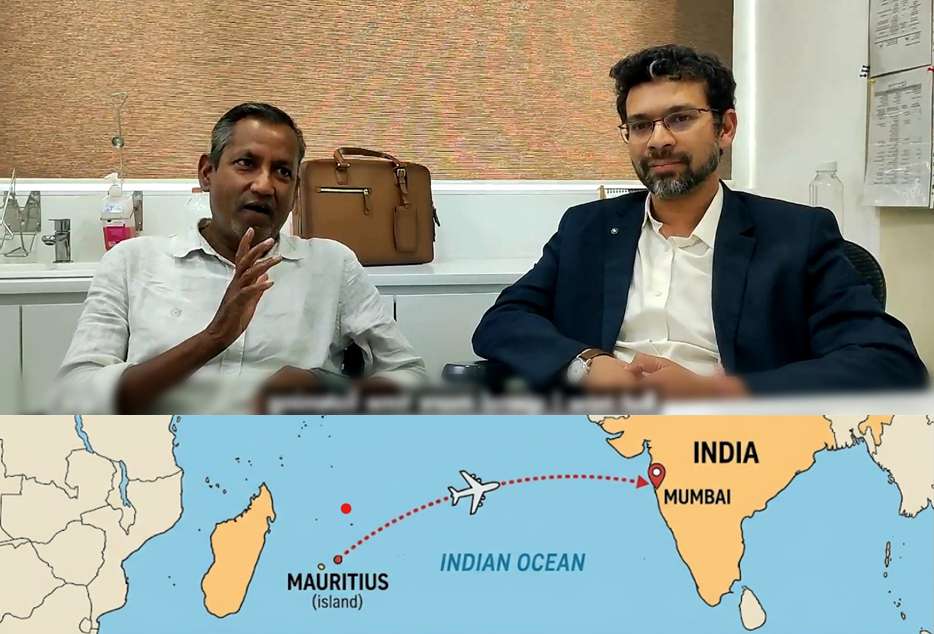
Sunil Jeetah, a 57-year-old from Mauritius, was living a full life when he was diagnosed with diffuse large B-cell lymphoma (DLBCL) — an aggressive cancer of the white blood cells. He completed a standard course of R-CHOP chemotherapy and achieved complete remission. Then, four months later, during a routine follow-up, his world collapsed. His doctors in Mauritius were candid: no further treatment was available on the island nation. He would need to go abroad.
A second opinion — and a path forward
Faced with an early relapse — often a marker of very high disease risk — Jeetah began researching treatment options in India. “The hospital’s medical team was so quick,” Jeetah says. “And when I met the doctor in Mumbai, he put my fears to rest. He spent a full hour explaining the entire protocol — what CAR-T is, how it works, what I needed to do. I was convinced he was the one who offered me a chance to fight this disease.”
“When a doctor is transparent with the outcomes and data, the patient finds the strength to fight from within.” — Sunil Jeetah, patient, Mauritius
A complex clinical picture
Jeetah’s case presented significant challenges. Dr Kunal Goyal, his treating oncologist at one the leading cancer hospital in Mumbai describes it as early relapsed DLBCL with aggressive features that had spread beyond the lymph nodes. “These patients don’t respond well to conventional treatment,” the oncologist explained while speaking with our team. “Even with a stem cell transplant, five-year survival is very poor. Our goal was to reduce the disease burden carefully and plan CAR-T in a way that offered the best possible chance of a durable response.”
He added: “You have to understand the patient’s immunology, their physical condition, their disease biology, and their social circumstances. Then you plan for that individual. That is what CAR-T requires.”
The treatment and what followed
Jeetah received India’s first indigenously developed CAR-T therapy, designed and manufactured by ImmunoACT, a company incubated at IIT Bombay in collaboration with Tata Memorial Centre. The infusion itself was painless. The weeks that followed required intensive, round-the-clock monitoring by medical and nursing staff.
After stabilising in Mumbai, he returned home. Immune-related complications emerged in the weeks that followed — but he was not alone in managing them. His treating oncologist remained reachable by phone and WhatsApp throughout his recovery.
“Over two months, he took care of me remotely from India,” Jeetah says. “I kept telling my wife — where do you find doctors who have the time and patience to track a patient even when they’re overseas?”
More than 18 months without evidence of disease
Today, Jeetah has crossed 18 months post-treatment, and his most recent assessments show no evidence of disease. His energy levels have largely returned to normal. He exercises regularly, watches his diet, and has resumed the activities that matter most to him.
“The side effects of CAR-T were much fewer and less intense than chemotherapy,” he reflects. “Now I spend more time doing things that are meaningful.”
His oncologist notes that in aggressive, early-relapsed lymphoma, outcomes without CAR-T are typically poor. For carefully selected patients who respond well to CAR-T, the therapy may offer a chance of sustained and durable disease control.
Not cheaper but world-class care — at a fraction of the cost.
For years, CAR-T therapy existed at a price point that placed it beyond reach for most of the world. In the United States and Europe, a CAR-T infusion can cost upwards of $300,000. India has changed that through innovation and by building a domestic manufacturing capability that has demonstrated comparable clinical outcomes at approximately one-tenth of that figure.
ImmunoACT’s CAR-T has touched the lives of more than 650 patients since receiving CDSCO approval. Its world’s first humanised CAR design — an engineering distinction intended to reduce the severity of immune-related side effects such as cytokine release syndrome — is one reason clinicians cite it as a meaningful clinical advance, not merely a lower-cost alternative.
For patients like Jeetah — from countries where CAR-T is simply unavailable — India’s manufacturing capability is not just an economic convenience. It is a clinical option where previously none existed.
Note: CAR-T therapy may cause side effects that are severe or life-threatening, requiring intensive monitoring and specialised hospital care. Treatment outcomes vary based on disease characteristics, prior therapies, and individual patient factors. Patients considering CAR-T therapy are advised to discuss the full risk-benefit profile with their treating physician. The content reflects individual experiences and is not a guarantee of outcomes.
The article is written for knowledge and educational purposes only. The views expressed are those of the author and do not necessarily reflect the views of any organization mentioned in the article.
