

The Earth is often celebrated as the “blue planet,” a symbol of abundance and life. With nearly 70% of its surface covered in water, it gives the impression of limitless availability. However, beneath this visual vastness lies a far more sobering reality—one that challenges our assumptions about water security and sustainability.
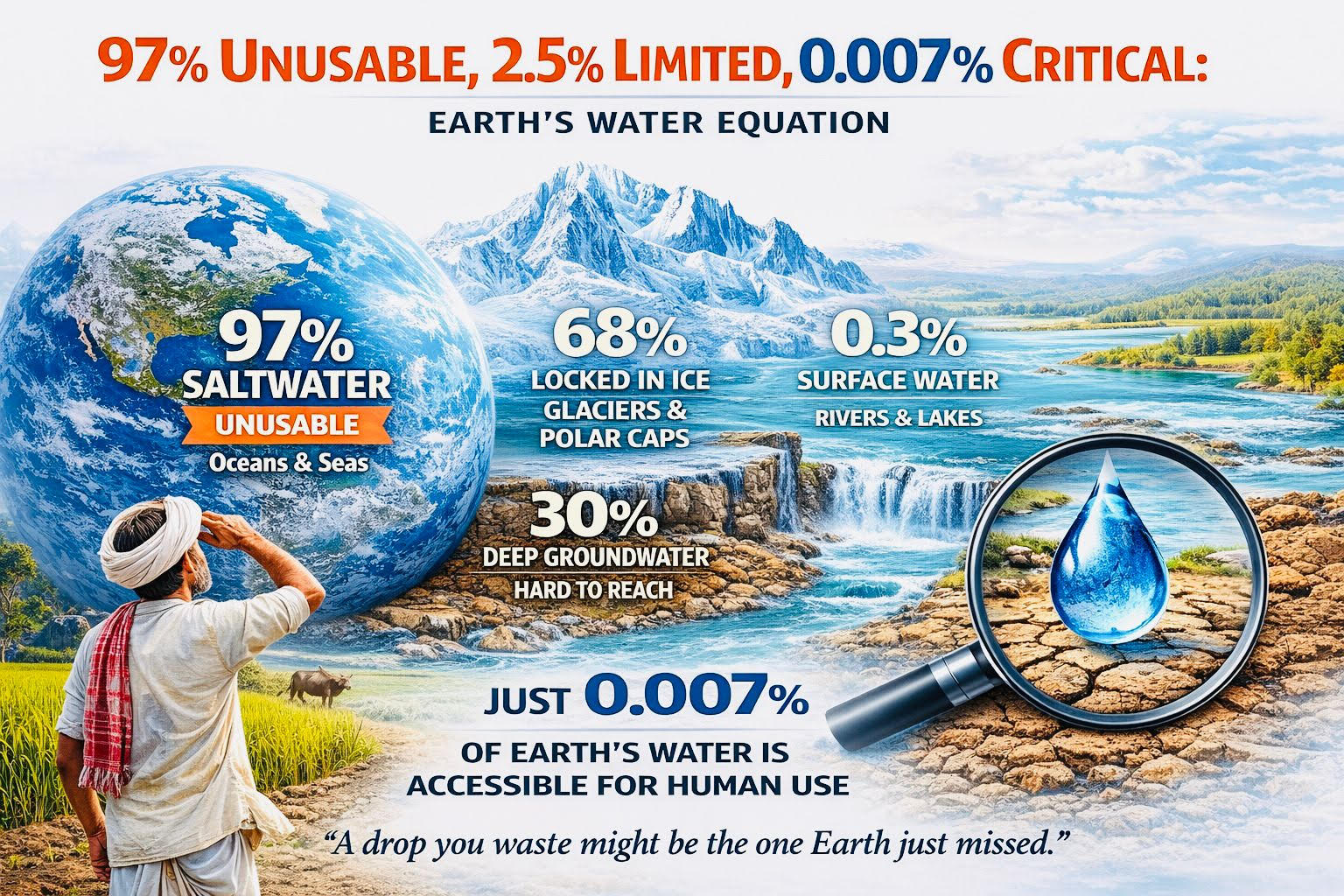
“A drop you waste might be the one Earth just missed. Approximately 97% of the Earth’s water is saline, spread across oceans and seas, making it unfit for direct human consumption. The remaining 2.5% is freshwater, but even this seemingly usable share is largely out of reach. Nearly 68–69% of freshwater is locked in glaciers and polar ice caps, inaccessible to most of humanity. Another 30% exists as groundwater, much of it buried deep beneath the Earth’s surface, making extraction both technically challenging and economically expensive” says Pavan Kaushik, who is Co-founder of Gurukshetra Consultancy, an Author and Storyteller, and writes on contemporary topics.
“What remains is a minuscule fraction—surface water found in rivers, lakes, and wetlands—which constitutes just about 0.3% of freshwater. In the context of total global water, this translates to approximately 0.007%. This is the water that sustains billions of people, supports agriculture, powers industries, and maintains ecosystems. It is, in every sense, the lifeline of civilization”, Pavan Kaushik adds.
Pavan Kaushik says, “The crisis is not in how much water exists, but in how little we can actually use. The true challenge, therefore, is not the absence of water, but the severe limitation of its accessibility. As global populations rise, urbanization accelerates, and climate patterns become increasingly unpredictable, the pressure on this tiny fraction intensifies. Rivers are shrinking, groundwater tables are declining, and pollution continues to degrade already limited resources.”
Compounding the issue is a widespread misconception: that water is abundant simply because it is visible. This illusion has led to complacency in conservation and inefficient usage across sectors. In reality, water is not just a natural resource—it is a strategic asset that influences food security, public health, economic growth, and even geopolitical stability.
“Addressing this challenge requires a shift not only in policy and technology, but also in individual behaviour. Conservation begins at the most personal level—how we use water in our daily lives. Every drop saved contributes to a larger collective impact. Drink as much water as you need—water sustains life. But every drop wasted is a loss we can no longer afford”, Pavan Kaushik says.
Simple actions—fixing leaks, reducing unnecessary usage, reusing water where possible, and being mindful in consumption—can collectively create meaningful change. The responsibility of water conservation does not lie solely with governments or institutions; it rests equally with each one of us.
The equation is simple, yet profound. The majority of Earth’s water is unusable, a small portion is limited, and an almost negligible fraction is critical for survival. Recognizing this imbalance is the first step toward meaningful action.
Pavan Kaushik says, “Water is not scarce because it is absent—it is scarce because it is accessible only in the smallest measure where it matters most.”
